

Fluconazole Drug Interactions: A Review Checklist
Fluconazole can change how the body handles a range of medicines, so interaction screening should use the complete medication list rather than a short memory-based check. A prescriber or pharmacist considers each drug, timing, health conditions, and monitoring needs before deciding whether fluconazole is appropriate.

Medically reviewed by
Infectious diseases and antimicrobial stewardship
Medical review completed August 27, 2026
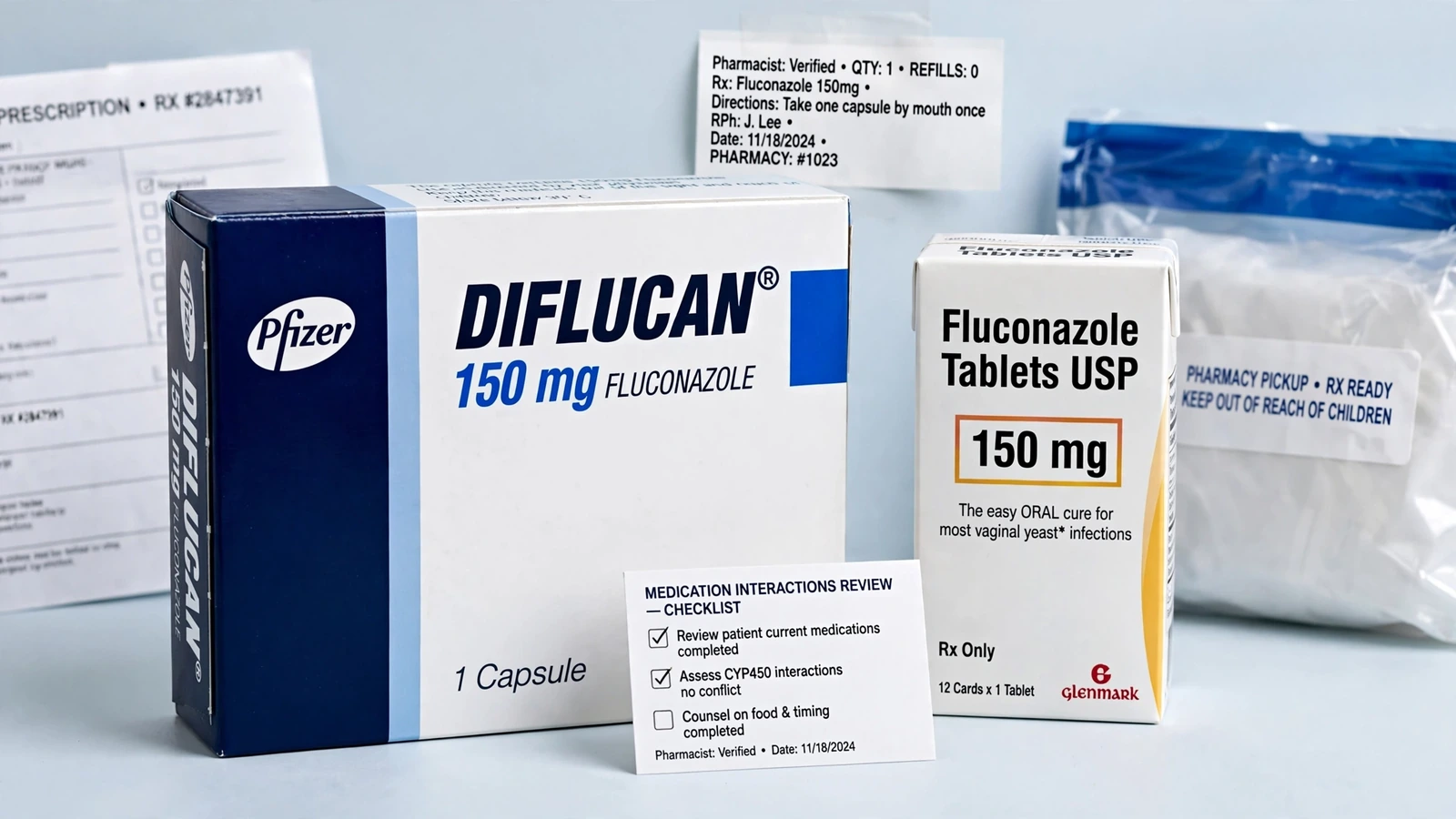
List section and what to record
| Decision point | What it can mean | Safer action |
|---|---|---|
| Daily prescriptions | Name, strength, schedule, reason, and prescriber. | Do not rely on pill color or shape. |
| Occasional medicines | Pain, sleep, allergy, nausea, or cold products. | Combination products may hide ingredients. |
| Supplements and herbs | Exact label and frequency. | Natural does not mean interaction-free. |
| Recent changes | Started, stopped, missed, or dose-changed products. | Timing can affect interpretation. |
A safer step-by-step pathway
Gather labels or portal records
Use exact product names instead of memory.
Combine lists from every prescriber
Include urgent care, specialists, dental care, and telehealth.
Add supplements and occasional products
These are commonly omitted during short visits.
Flag heart, liver, and kidney history
Relevant conditions can change the risk assessment.
Ask for a final reconciled plan
Know what continues, what changes, what is monitored, and whom to contact.
Why lists of interacting drugs are not enough
Official labeling contains many interaction categories, but a patient decision depends on dose, timing, indication, alternatives, organ function, and monitoring. A public list can also become outdated or omit combination products. Use it to prompt a medication reconciliation, not to make a unilateral change.
How fluconazole creates interaction risk
Fluconazole inhibits drug-metabolizing enzymes and can increase exposure to some medicines. It also has its own heart-rhythm and liver considerations. The mechanism explains why the prescriber asks about drugs that may seem unrelated to an antifungal prescription. For more detail on this decision, review Fluconazole Safety, Interactions, and PrecautionsReturn to the parent clinical guide..
Combination products and brand names
Cold remedies, sleep aids, pain products, and supplements may contain multiple active ingredients. Record the exact front and ingredient labels or bring photographs. A pharmacist can translate brand names into active ingredients and identify duplicate or interacting therapy.
What not to do after spotting a possible interaction
Do not stop a necessary medicine, skip doses, or change timing without professional guidance. The appropriate response may be choosing another antifungal, adjusting a medicine, arranging monitoring, or deciding that the theoretical interaction is manageable.
Health conditions influence the same decision
Liver or kidney disease and a history of rhythm problems can affect how clinicians interpret the medication list. Report fainting, known QT concerns, organ disease, and relevant recent laboratory results. The prescriber decides which information changes the plan. A related clinical question is covered in How Fluconazole Fits Yeast Infection CareContinue with this related question in the same clinical branch..
Keeping the list useful after the visit
Update the list whenever a medicine starts, stops, or changes. Keep one copy accessible on your phone and share it with the dispensing pharmacist. If a new prescription is added while fluconazole is still relevant, request another interaction check rather than assuming the first review covers it.
Turn an interaction warning into a documented plan
An alert is the beginning of a review, not a direction to stop a medicine. Provide exact products, strengths, schedules, recent changes, and the reason each medicine is used. The prescriber or pharmacist can then decide whether the combination should be avoided, monitored, timed differently, or managed with an alternative antifungal.
Write down the decision and who made it. Include any symptom or laboratory monitoring, the time window in which the interaction matters, and the contact route if another medicine is added. This prevents a later clinician from seeing only a generic warning without knowing how it was resolved for the current plan.
Common mistakes that weaken the decision
- Checking only prescriptions from the clinician conducting the visit.
- Omitting supplements because they are marketed as natural.
- Stopping a medicine after reading an interaction list without advice.
- Using a brand name without recording its active ingredients.
Frequently asked questions
Can a pharmacist check my fluconazole interactions?
Yes. A licensed pharmacist can reconcile the complete list and contact the prescriber when a concern needs a treatment decision.
Should I stop an interacting medicine myself?
No. Ask the prescriber or pharmacist; abrupt changes can create a different risk.
Do supplements belong on the list?
Yes. Include vitamins, minerals, herbs, and occasional products with exact labels.
Why ask about fainting or rhythm history?
Fluconazole and some interacting medicines can affect cardiac rhythm, making this history relevant to review.
Where is the official interaction information?
Current U.S. labeling is available through DailyMed, but it still needs clinician or pharmacist interpretation for an individual.
Authoritative sources
Sources were checked for this version on August 27, 2026. Links open the official publisher in a new tab.
- Fluconazole Drug Information — MedlinePlus, U.S. National Library of Medicine, 2018-12-15
- Fluconazole Prescribing Information — DailyMed, U.S. National Library of Medicine, accessed 2026-08-27
- BeSafeRx: Know Your Online Pharmacy — U.S. Food and Drug Administration, accessed 2026-08-27