

ED physiology · PDE5 inhibition
How Tadalafil Works for ED—and What It Cannot Do
Tadalafil preserves part of the chemical signal that relaxes smooth muscle and supports penile blood flow during sexual stimulation. It does not create desire, switch on an erection by itself, or diagnose why ED is happening.

Medically reviewed by
Urology · Sexual medicine · Erectile dysfunction
Medical review completed August 27, 2026
The Erection Pathway Before Tadalafil Enters the Picture
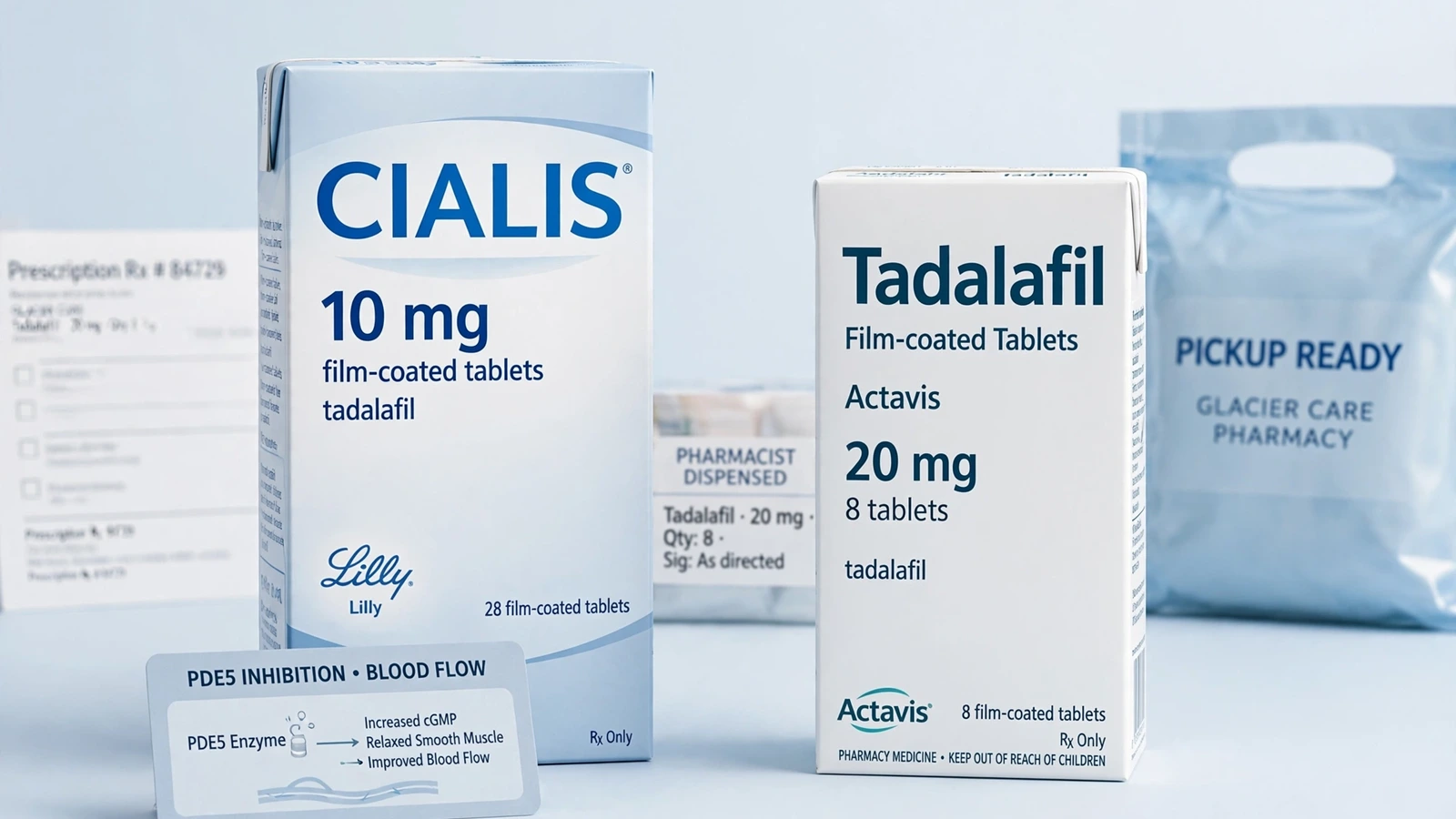
Sexual stimulation activates nerve and endothelial signals that release nitric oxide. That signaling increases cyclic guanosine monophosphate, often shortened to cGMP, in smooth muscle. The result is relaxation of smooth muscle and increased blood inflow, with pressure changes that help maintain rigidity. Phosphodiesterase type 5 breaks down cGMP and helps bring the signal to an end.
Tadalafil inhibits PDE5. By slowing cGMP breakdown, it can strengthen or prolong the erectile response to stimulation. The sequence matters: without the upstream sexual signal, there is little cGMP pathway for tadalafil to support. This explains why the medicine is not an aphrodisiac and why a tablet does not create a scheduled erection.
Stimulation starts signaling
Neural and vascular signals release nitric oxide in erectile tissue.
cGMP supports relaxation
Smooth muscle relaxes and blood flow can increase.
Tadalafil slows breakdown
PDE5 inhibition preserves cGMP signaling; it does not replace the first two steps.
What a Response to Tadalafil Means
| Observation | Reasonable interpretation | What it does not prove |
|---|---|---|
| Erections improve with stimulation | PDE5-supported blood-flow signaling is useful in this setting | That the underlying cause is identified or harmless |
| Response is inconsistent | Timing, stimulation, alcohol, adherence, interaction, expectations, or cause may vary | That a higher dose is automatically needed |
| No useful response | The regimen, use, diagnosis, or treatment category needs review | That all ED treatments will fail |
| Side effects occur | Systemic PDE5 and vasodilating effects may limit fit | That the medicine should be stopped or changed without advice, unless an urgent warning applies |
ED can result from vascular disease, diabetes, nerve injury, pelvic surgery, medicine effects, hormonal concerns, psychological factors, anatomical problems, or a mixture. Tadalafil acts on the response pathway; it does not reverse every contributor. Someone can respond well and still need cardiovascular risk assessment or diabetes care. Someone can respond poorly because the dominant problem lies elsewhere.
Why Tadalafil Has a Longer Response Window
Tadalafil remains active longer than sildenafil, and the Cialis label reports improved erectile function compared with placebo up to 36 hours after as-needed dosing. This is a window during which stimulation may produce a supported response. It does not mean a 36-hour erection, guaranteed activity at every moment, or permission to redose throughout the window.
Longer persistence has practical and safety implications. Planning can be less tied to a short clock, but interactions and adverse effects may also matter for longer. Emergency clinicians need to know when tadalafil was taken before considering nitrate treatment. Duration should be interpreted as a response window whose individual experience varies.
What Tadalafil Cannot Safely Be Asked to Do
It cannot make nitrate use compatible with a PDE5 inhibitor. It cannot clear someone for sexual activity when cardiovascular status makes sex inadvisable. It cannot replace examination for pain, curvature, trauma, or neurologic findings. It cannot make combining ED medicines safe, and it cannot turn an unlicensed online seller into a pharmacy.
It also cannot guarantee a response. Marketing often presents tadalafil as a duration product rather than a prescription medicine. That framing skips contraindications, blood-pressure interactions, organ-function limits, and urgent warnings. Mechanism explains potential benefit; eligibility determines whether that mechanism can be used responsibly.
How to Evaluate a “Not Working” Report
First confirm that the medicine was obtained from a licensed pharmacy and used exactly as prescribed. Then record stimulation, timing, the selected regimen, alcohol, food context, new medicines, side effects, and whether response occurred in some settings but not others. Review the ED diagnosis and whether pain, curvature, low desire, ejaculation changes, or systemic symptoms point to another problem.
Do not double the prescribed dose, take daily and as-needed products together, or add sildenafil on your own. A clinician may adjust the plan, but may instead recommend more attempts under correct conditions, change the regimen, investigate an underlying cause, or discuss a device, counseling, another medicine route, or specialist care.
Mechanism Questions
Is tadalafil an aphrodisiac?
No. It does not create sexual desire. It supports the erectile blood-flow response when sexual stimulation activates the pathway.
Why can tadalafil help for up to 36 hours?
Its pharmacokinetic profile supports a longer response window. The window is not a continuous erection and does not guarantee response at every point.
Does tadalafil response diagnose vascular ED?
No. Response shows that the supported pathway was useful, but it does not identify or exclude vascular, metabolic, neurologic, psychological, medicine-related, or anatomical causes.
Can more tadalafil overcome inadequate stimulation?
No safe conclusion follows from that assumption. Do not change the prescribed regimen. Review use, stimulation, expectations, interactions, and diagnosis with the prescriber.