

Uses and evidence · Human care
Trazodone Uses, Evidence and Treatment Fit
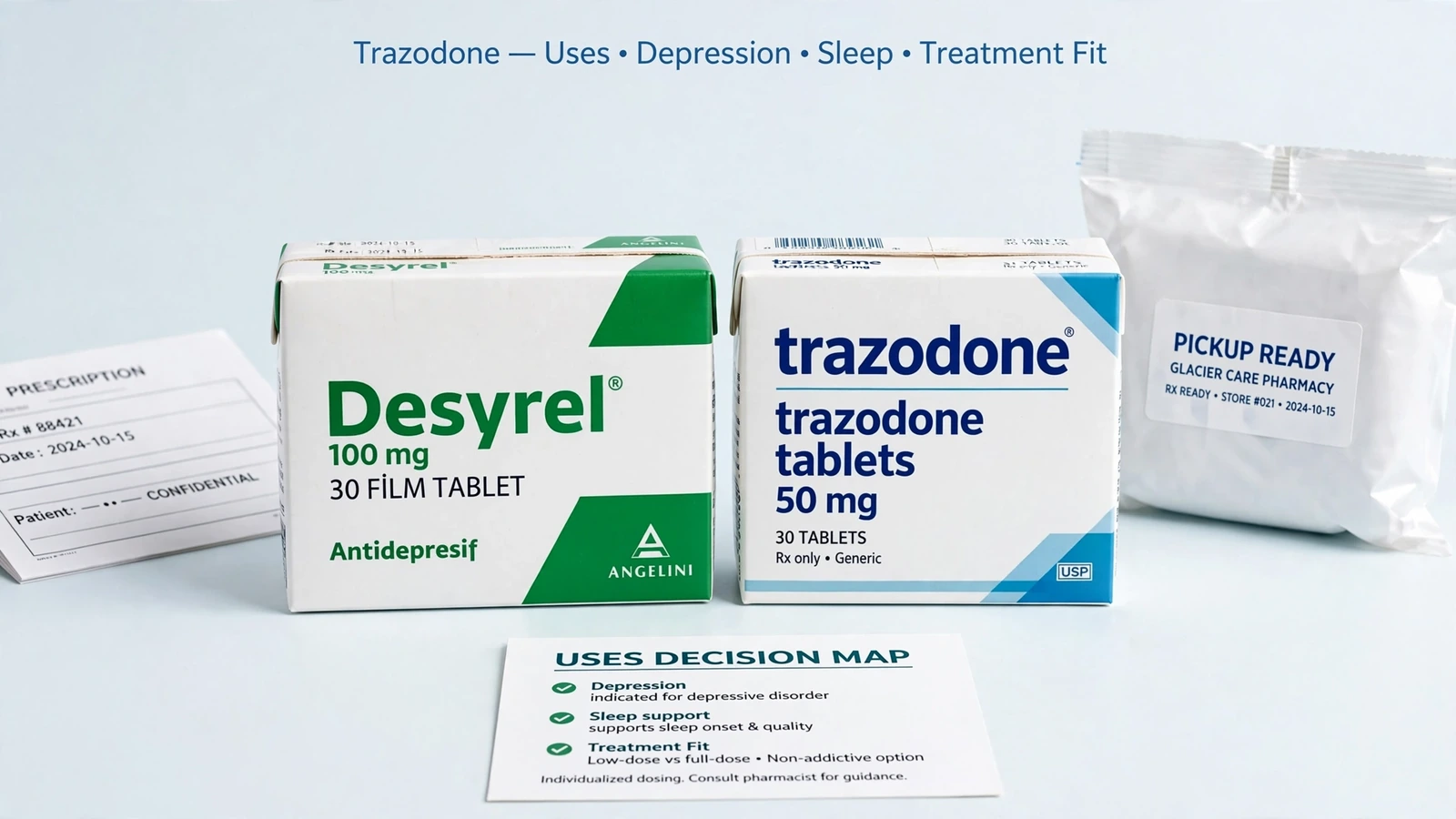
Trazodone is a prescription antidepressant with a U.S. label for major depressive disorder in adults. Its appearance in sleep-related care does not make insomnia a labeled indication. Treatment fit depends on the diagnosis, the person’s goals, prior response, safety history and the quality of follow-up rather than on the drug name alone.

Medically reviewed by
Psychiatry, addiction medicine and clinical informatics
Medical review completed August 27, 2026
Move from symptom to treatment fit
1. Define the problem
Describe symptom duration, severity, function and urgent concerns without starting from a preferred medication.
2. Confirm the treatment target
Separate adult major depression from insomnia, another mental-health condition or a medical cause.
3. Compare pathways
Review psychotherapy, medicines, combined care and the practical burdens of each option.
4. Set monitoring points
Agree on outcomes, side effects, safety signals and when the plan will be reconsidered.
Different questions require different evidence
| Reader question | Clinical focus | Boundary |
|---|---|---|
| Depression | Diagnosis and treatment plan | Adult labeled use |
| Sleep difficulty | Cause and insomnia pathway | Off-label context |
| Refill or continuation | Response and adverse effects | Not automatic |
| Animal behavior | Veterinary assessment | Outside human care |
The labeled use begins with adult major depressive disorder
DailyMed identifies trazodone hydrochloride tablets as indicated for major depressive disorder in adults. That statement defines the regulatory indication, not a self-diagnosis test. A clinician still evaluates the symptom pattern, duration, impairment, other possible causes and whether medication, psychotherapy or combined care fits the person’s situation.
Depression assessment is broader than low mood
NIMH describes depression as a condition that can affect feelings, thinking and daily activities such as sleeping, eating and working. A review can cover loss of interest, energy, concentration, appetite, sleep, guilt, hopelessness and thoughts of death. It also checks medical conditions, substances and medicines that can mimic or worsen symptoms.
Bipolar history can change the antidepressant decision
The prescribing information directs clinicians to screen for a personal or family history of bipolar disorder, mania or hypomania before starting an antidepressant. Periods of unusually elevated or irritable mood, reduced need for sleep, racing thoughts or impulsive behavior deserve careful discussion. An online form that never asks these questions is not a sufficient mental-health assessment.
Trazodone for sleep sits outside the labeled indication
MedlinePlus notes that trazodone is sometimes used for insomnia, while the DailyMed indication remains adult major depressive disorder. The distinction matters. An off-label decision should identify the sleep problem, examine other causes and weigh evidence and harms rather than assuming that sedating effects make a medicine the right long-term treatment. For more detail on this decision, review human trazodone prescription pathway.
Chronic insomnia has a dedicated treatment pathway
The 2025 VA/DoD insomnia guideline recommends cognitive behavioral therapy for insomnia as a treatment for chronic insomnia disorder. The 2017 AASM pharmacologic guideline suggests that clinicians not use trazodone for sleep-onset or sleep-maintenance insomnia. These recommendations do not replace individual judgment, but they make the evidence boundary visible.
Treatment goals should be observable
A plan can track mood symptoms, ability to work or care for responsibilities, engagement with other treatment, sleep pattern, adverse effects and safety concerns. The goal is not simply to continue a tablet. Clear outcomes help the patient and clinician decide whether to maintain, adjust or replace a pathway after an adequate and clinically supervised trial.
Side effects can outweigh a theoretical fit
Sedation, dizziness, orthostatic symptoms and other adverse effects can affect driving, falls, work and adherence. Serious warnings include serotonin syndrome, cardiac arrhythmias, bleeding, mania or hypomania, priapism and suicidal thoughts or behaviors in the populations described by the boxed warning. The relevant risks depend on history and co-medications.
Use and safety cannot be split into separate visits
The reason for considering trazodone is inseparable from the medicine list, heart and fainting history, bleeding risk, liver or kidney context, pregnancy or breastfeeding context and substance use. A prescription request that captures the treatment target but ignores safety cannot establish fit. The two parts belong in the same clinical decision.
Follow-up tests the original assumption
If symptoms do not improve, functioning worsens, sedation becomes disruptive or mood changes in an unexpected direction, the clinician may need to revisit the diagnosis and plan. Follow-up is also where new medicines, adherence problems and cost barriers become visible. Continuing by inertia is not the same as confirming benefit.
What this uses guide does not decide
It does not tell a reader which dose to take, promise that trazodone will work, authorize a prescription, recommend abrupt stopping or provide animal-care advice. It also does not treat every sleep complaint as depression. Each child article handles one narrower question so the evidence and safety boundary remain clear. A related clinical question is covered in trazodone clinical review online.
Choose the branch that matches the actual question
Use the clinical-review article to prepare history for an online evaluation, the depression article for labeled-use context and the sleep article for the off-label evidence boundary. Safety, interactions, dosing and stopping live in their own branches. Keeping those intents separate makes each page more useful and reduces the chance of treating a search phrase as a diagnosis.
Age and life context can change the discussion
The current label is an adult indication and says trazodone is not approved for pediatric patients. Older adults may have different concerns around falls, low blood pressure, sedation and multiple medicines. Pregnancy or breastfeeding context also deserves an individualized benefit-risk discussion. A single uses list cannot resolve these differences, so the assessment must name the person and setting behind the question.
Substance use belongs in a nonjudgmental review
Alcohol and other substances can affect mood, sleep, adherence and medication safety. The purpose of asking is not to disqualify someone from care. It is to identify withdrawal, interaction, impairment and treatment needs accurately. A clinician may need a dedicated substance-use pathway or closer coordination, especially when symptoms change around use, reduction or relapse.
A review should end with a documented rationale
The patient should understand what condition is being treated, why this pathway was chosen, what alternatives were considered and what would prompt a change. A short written rationale helps future clinicians interpret the plan and prevents a long-standing prescription from becoming the only evidence that the original diagnosis still fits.
Questions readers ask after this review
What is trazodone used for?
The checked U.S. label identifies trazodone hydrochloride tablets for major depressive disorder in adults.
Is trazodone used for insomnia?
It is sometimes prescribed off-label for sleep, but insomnia is not the labeled indication and guidelines require a separate evidence discussion.
Can trazodone treat every kind of depression?
No medicine fits every person. Diagnosis, severity, prior treatment, safety history, preferences and follow-up shape the plan.
Why ask about past high-energy periods?
Possible mania or hypomania can change diagnosis and treatment safety, so the label directs screening before antidepressant treatment.
Does this guide cover animal use?
No. Veterinary trazodone questions require a veterinarian and are outside this human-care topic collection.
Primary and authoritative sources
- DailyMed, U.S. National Library of Medicine: Trazodone hydrochloride tablet prescribing information — label updated August 19, 2026; checked August 27, 2026.
- MedlinePlus, U.S. National Library of Medicine: Trazodone drug information — checked August 27, 2026.
- U.S. Department of Veterans Affairs and Department of Defense: Clinical Practice Guideline for the Management of Major Depressive Disorder — 2022 guideline; checked August 27, 2026.
- National Institute of Mental Health: Depression — reviewed December 2024; checked August 27, 2026.
- American Academy of Sleep Medicine: Clinical Practice Guideline for the Pharmacologic Treatment of Chronic Insomnia in Adults — 2017 guideline; checked August 27, 2026.
- U.S. Department of Veterans Affairs and Department of Defense: Clinical Practice Guideline for Chronic Insomnia Disorder and Obstructive Sleep Apnea — 2025 guideline; checked August 27, 2026.
- Substance Abuse and Mental Health Services Administration: 988 Suicide & Crisis Lifeline — checked August 27, 2026.
Educational information for human care only. This page does not diagnose a condition, guarantee a prescription, select an individual dose, replace a clinician or provide veterinary advice.