

Furosemide Prescription Continuity and Refill Review
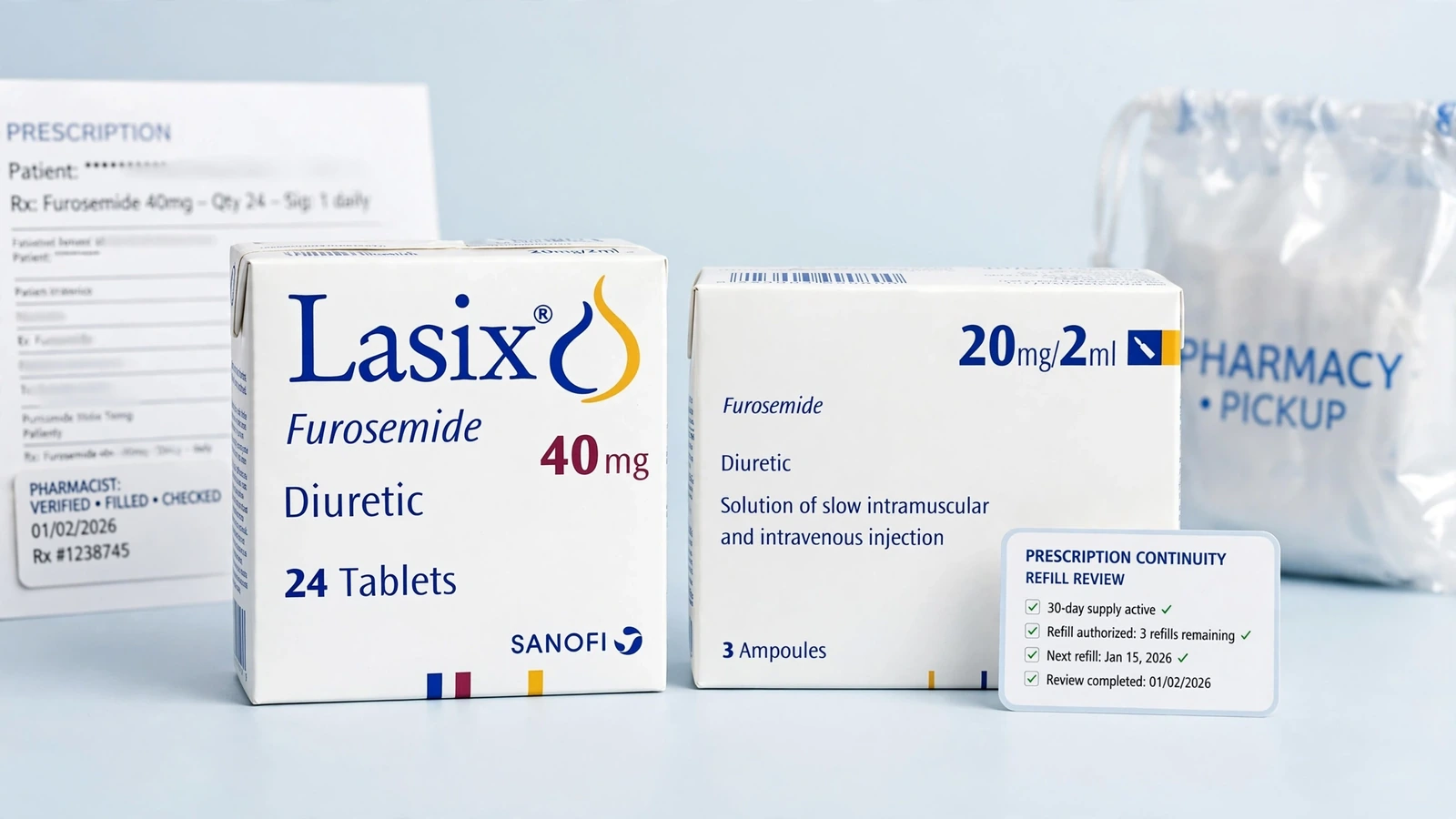
A furosemide refill is safest when it confirms the current indication, dose, monitoring, symptoms, interacting medicines, and care plan. Continuity does not mean automatic renewal: a clinician may need records, laboratory testing, medication reconciliation, or an in-person assessment before prescribing.

Medically reviewed by
Internal medicine · drug safety · pharmacoepidemiology
Medical review completed August 27, 2026
A refill review checks whether the old plan still fits
Furosemide directions may change after hospitalization, a new diagnosis, worsening kidney function, a change in swelling, or addition of another blood-pressure medicine. The bottle in the cabinet may not represent the latest plan. A continuity review should identify who prescribed the current regimen, why it is being used, what changed since the last prescription, and whether the patient is taking it as labeled. This prevents an old dose from being renewed simply because it exists in the chart.
Medication reconciliation is more than copying a list
An accurate list includes drug name, strength, schedule, actual use, reason, prescriber, and recent start or stop dates. Include over-the-counter pain relievers, supplements, salt substitutes, and medicines taken only as needed. Duplicate entries, old hospital orders, and brand-versus-generic names can obscure what is really being taken. Photographing labels can help, but the reviewer still needs to know whether the directions match actual use.
Monitoring records make remote review more informative
Recent kidney-function and electrolyte results, blood-pressure readings, weight trends when requested, and relevant symptoms help a clinician judge stability. A result without a date or a home reading without context is less useful. Record major illness, vomiting, diarrhea, poor intake, fainting, reduced urination, or worsening breathing. Missing information may reasonably lead to a laboratory order or in-person assessment before a refill decision.
Care transitions are a high-risk moment
Discharge paperwork may contain temporary instructions, while a specialist or primary-care clinician later changes the plan. Compare the discharge list, current bottle, patient portal, and most recent clinician instructions. If they conflict, do not average the doses or choose the easiest schedule. Contact the team responsible for the transition and document which instruction supersedes the others. A clear owner for laboratory follow-up and refills reduces duplication.
Pharmacy continuity still requires verification
A familiar-looking website or repeated order history does not prove that a pharmacy remains appropriate. Confirm the pharmacy’s current license, contact details, prescription requirement, and pharmacist access. When transferring a prescription, check whether remaining refills, product, strength, and directions match. If the pharmacy reports a discrepancy, pause the transaction and resolve it with the prescriber rather than asking for an unauthorized substitution. For more detail on this decision, review Prescription access overviewReturn to the safe Lasix and furosemide access pathway..
Build a plan for the next interruption
Before the supply runs low, know the renewal window, expected review interval, laboratory schedule, and contact route for travel or an unexpected closure. Keep medicines in their labeled containers and do not share tablets. If a refill is delayed, the appropriate response depends on the indication and clinical status; do not double a later dose or obtain an uncertain product to bridge the gap.
Reconcile the active direction before requesting continuity
A refill review should compare the bottle, portal list, discharge summary, specialist plan, and actual use. If they disagree, the task is clarification, not selection of the most recent-looking document. Record the indication, exact schedule currently followed, remaining supply, missed doses, and the clinician who owns the plan. That record distinguishes a routine continuation request from an unresolved medication discrepancy.
Bring the evidence that could change renewal
Include dated symptoms, relevant home measurements only when requested, recent kidney and electrolyte results, blood pressure, and any acute illness or care transition. List prescriptions, over-the-counter products, supplements, and salt substitutes with recent starts and stops. New dizziness, falls, hearing symptoms, reduced urination, worsening breathing, or unexpected swelling may change whether routine remote renewal is appropriate.
Protect continuity when dispensing is delayed
Do not borrow another person’s medicine, combine old and new directions, or use an unverified seller to bridge a gap. Contact the prescribing team and pharmacy early, explain the remaining supply, and ask for the approved next step. A safe response may involve record review, a short clinical reassessment, laboratory work, or another care setting; it is not automatically the same refill. A related clinical question is covered in Lasix Refill Continuity: What a Review RechecksA Lasix refill review should recheck the current indication, labeled dose, actual use, recent symptoms, kidney function, electrolytes, and complete medicine list..
Finish with a named follow-up owner
The final plan should identify the active instructions, dispensing pharmacy, next monitoring date, responsible reviewer, and route for questions. It should also state what to do if the pharmacy cannot fill the product or if symptoms change before the next appointment. This prevents the prescription from becoming detached from the condition, laboratory plan, and clinicians responsible for ongoing safety.
Plan the request around records and monitoring, not only supply
Begin the refill process early enough to gather results and resolve questions without creating pressure for automatic approval. Check whether laboratory orders are complete, whether another clinician changed the regimen, and whether the listed pharmacy can dispense the current product. If a required result is missing, document who will arrange it and when the prescribing decision will be revisited. If the situation has become unstable, redirecting to examination or urgent care protects continuity better than issuing a prescription that no longer matches the clinical picture.
Retire obsolete instructions from the working record
An old bottle or portal entry can remain visible after the care team has changed the plan. Mark obsolete directions clearly and ask the responsible clinician or pharmacy how they should be handled. Do not keep multiple schedules available for convenience. A single dated source of truth reduces dosing confusion during care transitions and makes the next review faster because the reviewer can see both the active direction and the reason earlier instructions were replaced. Confirm that the pharmacy profile also reflects the current schedule. Date the confirmed update.
A practical decision pathway
Reconcile
Compare the current bottle, actual use, care-transition records and complete medication list.
Document
Attach dated monitoring results, symptoms and relevant home measurements.
Review
A clinician confirms whether continuation, testing, adjustment or in-person care is appropriate.
Coordinate
Verify the pharmacy and record who owns the next refill and monitoring step.
Decision table
| Continuity item | Useful evidence | Common mismatch |
|---|---|---|
| Dose | Current labeled bottle plus latest clinician instruction | Old bottle differs from discharge plan |
| Monitoring | Dated laboratory results and follow-up plan | Result has no date or responsible clinician |
| Medicines | Actual prescription, OTC and supplement use | Chart list contains stopped or duplicate items |
| Pharmacy | Verified license, prescription and pharmacist access | Seller identity or product source is unclear |
Frequently asked questions
Is a furosemide refill automatic?
No. A clinician may need to confirm the indication, current dose, monitoring, symptoms and medicine list before deciding whether continuation is appropriate.
What records should I prepare?
Bring the current label, complete medication list, recent laboratory results, relevant blood-pressure or weight records, and any discharge or specialist instructions.
What if my bottle and discharge paperwork disagree?
Do not choose or combine instructions on your own. Contact the clinician responsible for the transition and ask which plan is current.
Can a pharmacy transfer my furosemide prescription?
Transfer rules and remaining-refill status vary. The licensed pharmacies and prescriber can confirm whether the prescription is transferable and whether the directions match.
What if I run out before review?
Contact the clinical team and pharmacy promptly. The safe next step depends on the indication and current condition; do not borrow medicine or double a later dose.
Primary sources
Medical content reviewed August 27, 2026. References were checked on the dates shown.
- Furosemide tablet — prescribing information — U.S. National Library of Medicine, DailyMed. Updated June 23, 2026.
- Furosemide — U.S. National Library of Medicine, MedlinePlus. Accessed August 27, 2026.