

Response window · Tadalafil timing
How Long Tadalafil Lasts: Window, Onset, and Limits
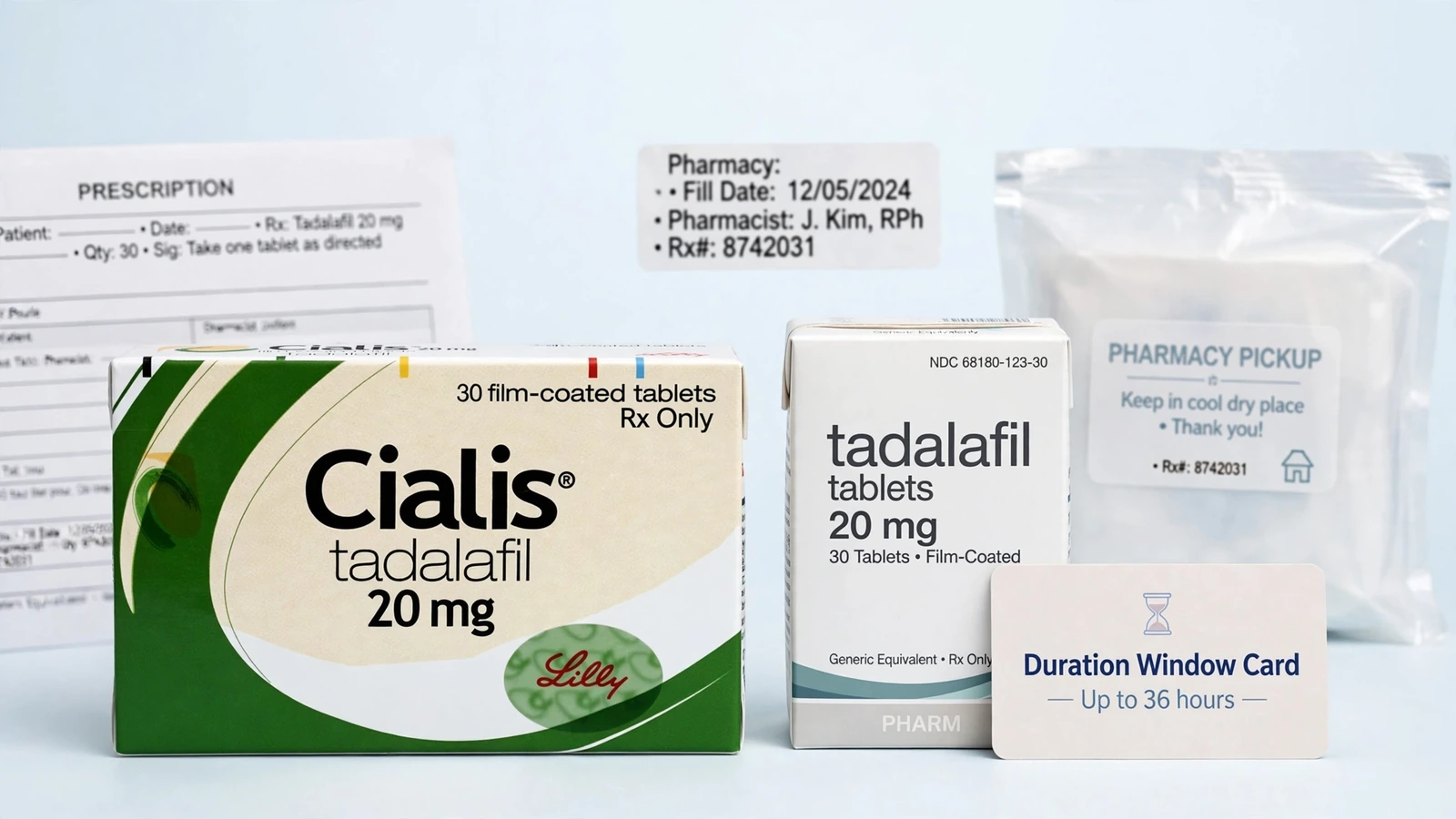
The Cialis label reports improved erectile function compared with placebo up to 36 hours after as-needed dosing. That is a response window with sexual stimulation—not a 36-hour erection, an instant onset promise, or permission to repeat the dose.

Medically reviewed by
Urology · Sexual medicine · Erectile dysfunction
Medical review completed August 27, 2026
Three Different Clocks Are Often Confused
Onset
How long it takes before a useful response may be possible under the prescribed conditions. It varies and still requires stimulation.
Response window
The period after an as-needed dose during which erectile function may be supported. The label’s finding extends up to 36 hours.
Clearance
How long the body takes to reduce the medicine. Interaction relevance can continue after the obvious benefit seems gone.
Marketing often collapses these clocks into “lasts 36 hours.” That phrase can suggest a continuous effect, but erectile response remains event-dependent. A person may have a useful opportunity at one point in the window and not another because stimulation, anxiety, alcohol, illness, the ED cause, and expectations differ.
What the Label’s 36-Hour Finding Does and Does Not Say
| Statement | Accurate? | Reason |
|---|---|---|
| Tadalafil can support erectile response up to 36 hours after an as-needed dose | Yes, as a labeled clinical finding | Response was improved compared with placebo; individual results vary |
| Tadalafil causes an erection for 36 hours | No | Sexual stimulation is required and prolonged erection is an emergency, not the intended effect |
| If nothing happens quickly, another dose is appropriate | No | Onset varies and redosing must follow the prescription |
| Nitrate risk ends when the erection benefit feels gone | No safe assumption | The medicine can remain relevant after the perceived response; emergency clinicians need the last-dose time |
Why Tadalafil Duration Varies
Kidney and liver function can change clearance. Potent CYP3A4 inhibitors can increase tadalafil exposure, while inducers can reduce it. The daily versus as-needed regimen changes the exposure pattern. Age and other health factors may matter through organ function and coexisting medicines rather than through a simple age cutoff.
Food does not impose a label restriction for Cialis, but alcohol can worsen blood-pressure effects and erectile performance. Inadequate stimulation, anxiety, pain, relationship context, or an untreated contributor to ED can make the useful window seem shorter even when the medicine is present.
Daily Use Changes the Meaning of “How Long”
Once-daily tadalafil is designed around consistent daily administration rather than a single event window. It creates ongoing exposure, so the question becomes whether the routine provides acceptable response and tolerability across time. Missing doses, taking doses at widely varying times, or adding an as-needed tablet can make both benefit and safety harder to interpret.
Follow the prescription and pharmacy leaflet for missed doses. Do not double a dose or use another PDE5 inhibitor to fill a perceived gap. The daily-versus-as-needed comparison explains why the two regimens are not interchangeable.
When a Long Window Becomes a Safety Issue
The nitrate contraindication is particularly important because tadalafil persists. Chest symptoms after use require emergency assessment and disclosure of the last dose; do not self-administer nitroglycerin. Substantial alcohol, alpha-blockers, and antihypertensives can contribute to dizziness or fainting. A new interacting medicine can matter even if tadalafil has been tolerated before.
What to Review When Duration Seems Too Short
Confirm the product came from a licensed pharmacy and was used exactly as prescribed. Review stimulation, timing, alcohol, new medicines, adverse effects, and whether ED occurs in all settings. A short or inconsistent experience may reflect the underlying diagnosis rather than rapid drug clearance.
A clinician may reconsider the regimen, use instructions, interactions, or diagnosis. The answer is not automatically a higher strength. More exposure can increase headache, indigestion, back pain, muscle aches, dizziness, and blood-pressure effects without addressing the cause.
Also distinguish a short useful response from difficulty maintaining an erection because stimulation paused, anxiety increased, pain occurred, or the sexual setting changed. Those details can redirect the evaluation toward the underlying ED pattern. A precise timeline is more clinically useful than the single statement that the medicine “wore off.”
Duration Questions
Does tadalafil work immediately?
No onset is guaranteed. Follow the prescribed timing, allow for stimulation, and discuss repeated delayed response with the prescriber rather than redosing.
Is the effect gone as soon as erections stop?
Not necessarily. The visible response depends on stimulation, while the medicine can remain in the body. Interaction precautions can still matter.
Can kidney disease make tadalafil last longer?
Reduced kidney function can increase exposure and change regimen limits. The prescriber should assess kidney status; do not self-adjust.
Why does the same dose feel different on different days?
Stimulation, alcohol, stress, illness, other medicines, adherence, and the underlying ED pattern can all change the experience.