

Formulation comparison
Metformin Immediate-Release vs Extended-Release
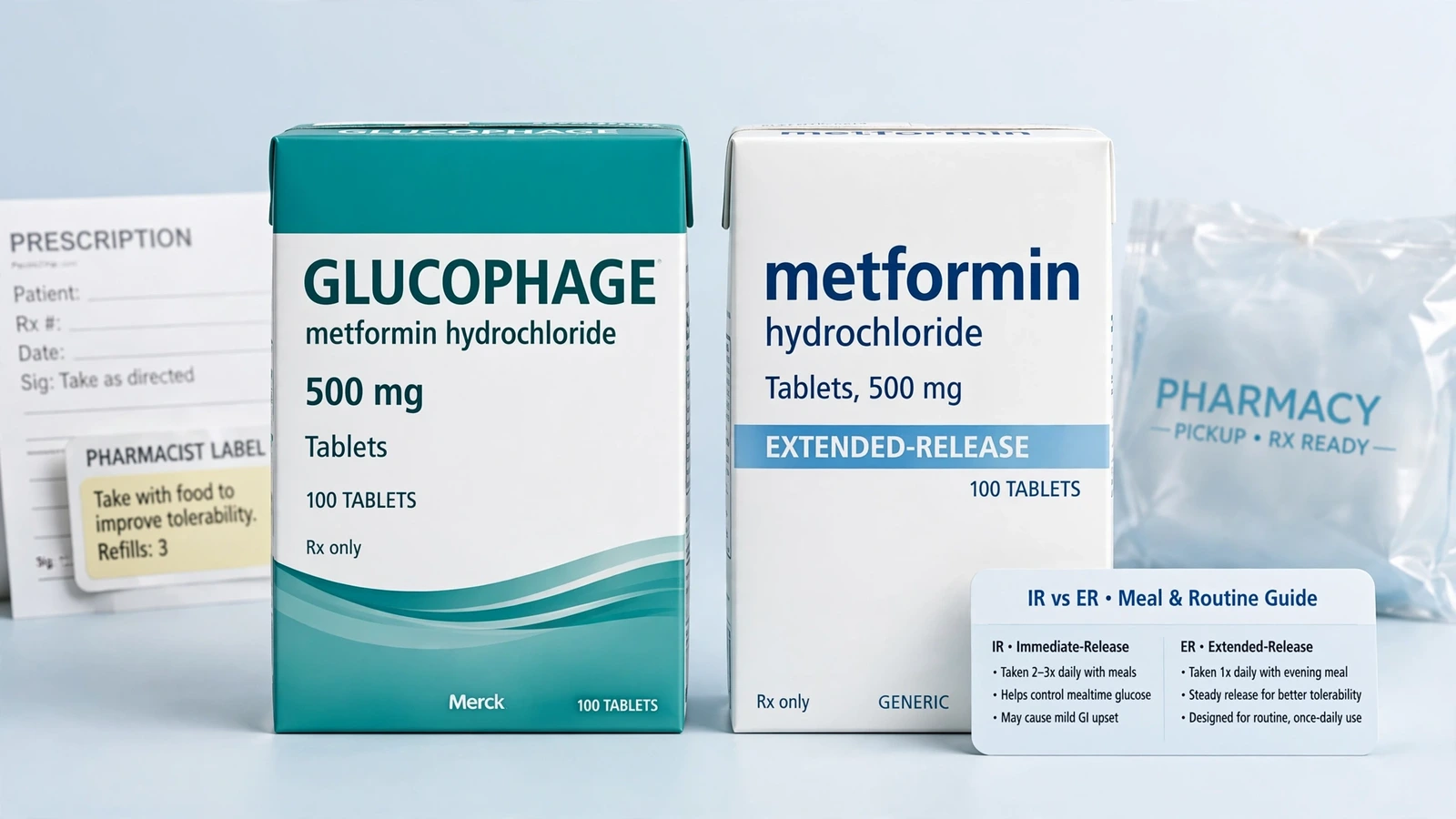
Metformin immediate-release and extended-release products contain the same active medicine but release it differently. That changes label directions, tablet handling and how the schedule fits daily life. Extended-release tablets generally must be swallowed whole. A switch should be confirmed by the prescriber and pharmacist because strengths, instructions and product details are not interchangeable.

Medically reviewed by
General internal medicine and preventive medicine
Medical review completed August 27, 2026
A practical route through this decision
Read the label
Confirm IR, ER or XR, strength, directions and whether the tablet may be split.
Describe the problem
Record symptom timing, meals, missed doses and the effect on daily routine. For more detail on this decision, review Metformin Treatment Decisions for Type 2 Diabetes.
Confirm the change
Use the new pharmacy label and discard copied instructions from the prior product. A related clinical question is covered in How Metformin Fits Type 2 Diabetes Treatment.
| Feature | Immediate-release | Extended-release |
|---|---|---|
| Release | Faster product release | Prolonged product release |
| Directions | Product-specific schedule | Often once daily |
| Tablet handling | Check label | Swallow whole |
| Switching | Needs confirmation | Needs confirmation |
Release pattern is a product property
IR and ER describe how the formulation releases metformin, not whether one is “stronger.” The prescribed strength and schedule determine total exposure. A product change can alter timing and tolerability, so the new label replaces the old routine. Do not infer equivalence from tablet color, shape or a similar-looking listing.
Meals and timing need the actual prescription
MedlinePlus states that regular tablets are usually taken with meals and extended-release tablets are usually taken with the evening meal. Those are general patient directions, not a personalized schedule. Follow the pharmacy label. If the wording is unclear or conflicts with prior instructions, pause and ask the pharmacist.
Tolerability is a pattern to document
Some people discuss extended-release products after gastrointestinal symptoms, but a formulation switch is not a guaranteed fix. Note the start date, severity, meals, hydration, missed doses and any recent increase or pharmacy substitution. Persistent vomiting, severe diarrhea or dehydration needs prompt clinical advice rather than a routine formulation comparison.
Extended-release tablets require handling care
Official information tells patients to swallow extended-release tablets whole and not split, chew or crush them. If swallowing is difficult, ask about appropriate alternatives. Do not alter the tablet to make it easier without confirming that the specific product permits it.
A safe switch has a closed loop
The prescriber selects the new formulation and directions. The pharmacy dispenses the intended product and can explain labeling. The patient confirms what arrived, follows the new instructions and reports symptoms or unexpected glucose patterns. The next review checks whether the original problem improved without creating a new adherence issue.
Insurance and availability can force a practical conversation
A plan may change when a preferred product is not covered or the pharmacy cannot obtain it. Confirm whether the proposed substitute has the same release form and prescribed directions. Ask for the expected out-of-pocket amount for the exact product, but do not assume a cheaper listing is clinically interchangeable. If access repeatedly interrupts use, the prescriber and pharmacist should choose a sustainable option and document how the new schedule will be monitored.
What to record after a formulation change
Write down the date the new product began, the old and new label wording, meals, gastrointestinal symptoms, missed doses and any glucose information requested by the care team. Keep the old bottle only long enough to compare labels safely, then follow pharmacy disposal advice. At follow-up, report whether the original problem improved and whether the new routine created confusion or missed doses.
Questions readers raise after the main review
Is extended-release metformin stronger than immediate-release?
Not simply. The release pattern differs, while strength and prescribed schedule determine the regimen. Compare the exact labels rather than the abbreviations alone.
Can extended-release metformin be crushed?
Official patient information says extended-release tablets should be swallowed whole. Ask the prescriber or pharmacist about alternatives if swallowing is difficult.
Does ER always prevent stomach side effects?
No. It may fit some people differently, but symptoms can persist and may have another cause. A switch needs clinical review and follow-up.
Can the pharmacy substitute IR for ER?
The dispensed product must match the prescription and applicable substitution rules. Check the label and contact the pharmacist if the formulation differs from what you expected.
Should metformin be taken with food?
Follow the directions on the prescription label. Official patient information commonly directs metformin to be taken with meals, but the exact schedule depends on the formulation and prescribed plan. A pharmacist can clarify whether a specific product is immediate-release or extended-release.
Primary sources used for this page
- DailyMed: Metformin Hydrochloride Tablets prescribing information. Label updated January 29, 2025; checked August 27, 2026.
- MedlinePlus: Metformin drug information. Revised February 15, 2024; checked August 27, 2026.
Medical information is educational and does not replace diagnosis, prescribing, procedure instructions or emergency care from a clinician who knows the complete record.