

When Yeast Infection Symptoms Need Testing
Testing becomes more useful when yeast infection symptoms are new, uncertain, severe, recurrent, pregnancy-related, or unchanged after treatment. Because itching, burning, and discharge overlap with several conditions, a test or examination can prevent repeated treatment for the wrong cause and help identify complicated or non-albicans candidiasis.

Medically reviewed by
Infectious diseases and antimicrobial stewardship
Medical review completed August 27, 2026
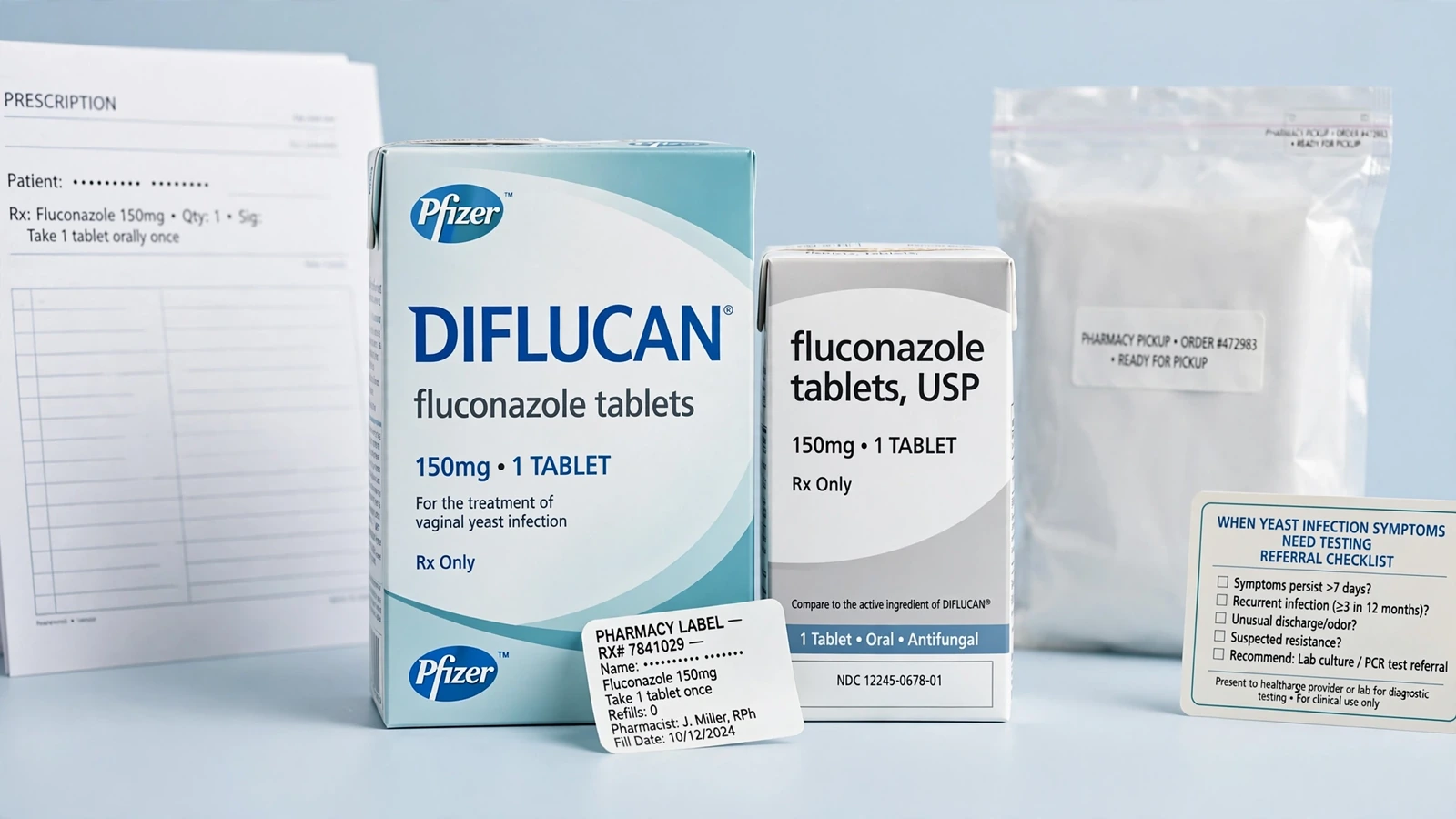
Situation and testing value
| Decision point | What it can mean | Safer action |
|---|---|---|
| Symptoms after treatment | Checks whether Candida is present or another condition better explains the course. | Avoid automatic repeat treatment. |
| Frequent episodes | Can support species identification and a longer-term care plan. | Bring a dated episode history. |
| New odor, pain, sores, or bleeding | Broadens the differential beyond uncomplicated candidiasis. | Seek clinician evaluation. |
| Pregnancy | Accurate diagnosis and treatment choice become more important. | Disclose pregnancy before any medicine. |
A safer step-by-step pathway
Document the episode
Write down onset, symptoms, tests, treatments, and response.
Explain prior confirmation
Say whether earlier episodes were diagnosed by a clinician or self-treated.
Discuss the possible tests
Ask what the selected test can and cannot establish.
Wait for interpretation
A result must be read alongside symptoms and examination findings.
Use the result for follow-up
The clinician should connect the finding to treatment and a reassessment plan.
Why testing is not needed in exactly the same way for everyone
A clinician may reasonably treat a narrow, familiar uncomplicated pattern without extensive testing, while another presentation needs examination and laboratory evidence. The difference comes from diagnostic confidence, severity, recurrence, pregnancy, health factors, and prior response—not from a blanket rule that all or no cases need testing.
What office evaluation may include
Depending on the setting, evaluation can include examination, vaginal pH, microscopy, culture, or another validated test. Each provides different information. Culture can help identify Candida species in complicated or recurrent cases, while broader testing may be needed when bacterial vaginosis, trichomoniasis, cervicitis, or another cause is possible. For more detail on this decision, review Yeast Infection Symptoms and Evaluation GuideReturn to the parent clinical guide..
A positive finding needs clinical context
Candida can sometimes be present without causing the current symptoms. Clinicians interpret a result alongside the symptom pattern and examination rather than treating a laboratory label in isolation. The objective is to explain the patient's illness, not merely to detect an organism.
Why treatment failure should trigger a new question
When symptoms do not improve, repeating the same medicine assumes both the diagnosis and treatment were correct. Testing can challenge that assumption. It may identify another condition, a complicated infection, non-albicans Candida, or a noninfectious source of irritation.
Preparing for a useful appointment
Avoid hiding recent products or treatments because they may affect findings. Bring the names and dates of all antifungal or antibiotic use, the symptom timeline, pregnancy information, health conditions, and prior test results. Ask whether any product should be paused before the appointment. A related clinical question is covered in Online Yeast Infection Evaluation: What Clinicians CheckContinue with this related question in the same clinical branch..
How results change the plan
A result can support cause-specific treatment, show that another evaluation is needed, or redirect attention to a noninfectious problem. A good follow-up explanation includes what was found, how certain the interpretation is, what to do next, and when persistent or worsening symptoms require reassessment.
Prepare for testing so the result can change care
Testing is useful only when the result will be interpreted with the symptom pattern and used in a follow-up decision. Ask what specimen is needed, whether recent treatment could affect interpretation, and how results will be delivered. Record the clinician or service responsible for acting on the result rather than assuming the laboratory will provide treatment advice.
While waiting, avoid repeatedly adding antifungal products unless a clinician has advised them. New fever, pelvic pain, bleeding, sores, severe illness, or pregnancy-related concern should be reported promptly because those changes may alter both the urgency and the tests required.
Common mistakes that weaken the decision
- Testing only after many rounds of the same unsuccessful treatment.
- Assuming a home pH result confirms candidiasis.
- Using a positive organism result without relating it to symptoms.
- Failing to tell the clinician about recent intravaginal products or medicines.
Frequently asked questions
Do all yeast infection symptoms require a laboratory test?
No. The need depends on diagnostic confidence and clinical context, but uncertainty, recurrence, severity, pregnancy, or treatment failure increases the value of testing.
Can a vaginal pH test confirm candidiasis?
No single home result confirms the diagnosis. Clinicians interpret pH with symptoms, examination, and other tests.
Why might a culture be used?
Culture can help confirm Candida and identify species in recurrent, complicated, persistent, or unclear presentations.
What if a test finds Candida but I have no symptoms?
A clinician should interpret whether the finding explains the presentation; detection alone does not always require treatment.
Should I use treatment before the test?
Ask the testing clinician, because recent products may affect evaluation and the right timing depends on the situation.
Authoritative sources
Sources were checked for this version on August 27, 2026. Links open the official publisher in a new tab.
- CDC STI Treatment Guidelines: Vulvovaginal Candidiasis — Centers for Disease Control and Prevention, 2021-07-22
- Diseases Characterized by Vulvovaginal Itching, Burning, Irritation, Odor or Discharge — Centers for Disease Control and Prevention, 2021-07-22
- Treatment of Candidiasis — Centers for Disease Control and Prevention, 2024-04-24