

Finasteride vs Minoxidil: Comparing Hair Loss Treatment Paths
Finasteride and minoxidil differ in route, prescription status, daily routine, adverse-effect profile, and the questions a patient should ask. They may be considered separately or together, but neither is automatically the right choice for every person with thinning hair.

Medically reviewed by
Urology and men’s health · medication safety and reproductive considerations
Medical review completed August 27, 2026
A practical decision pathway
Confirm diagnosis
Both options depend on the underlying cause.
Compare routines
Choose a sustainable oral or scalp routine.
Compare risks
Use product-specific labeling and history.
Set one review plan
Track start dates, symptoms, and photographs.
| Feature | Finasteride | Topical minoxidil |
|---|---|---|
| Access | Prescription | Nonprescription |
| Route | Oral tablet | Applied to scalp |
| Routine burden | Tablet schedule | Regular scalp application |
| Key discussion | Systemic risks and precautions | Scalp effects and product warnings |
Different mechanisms and routes
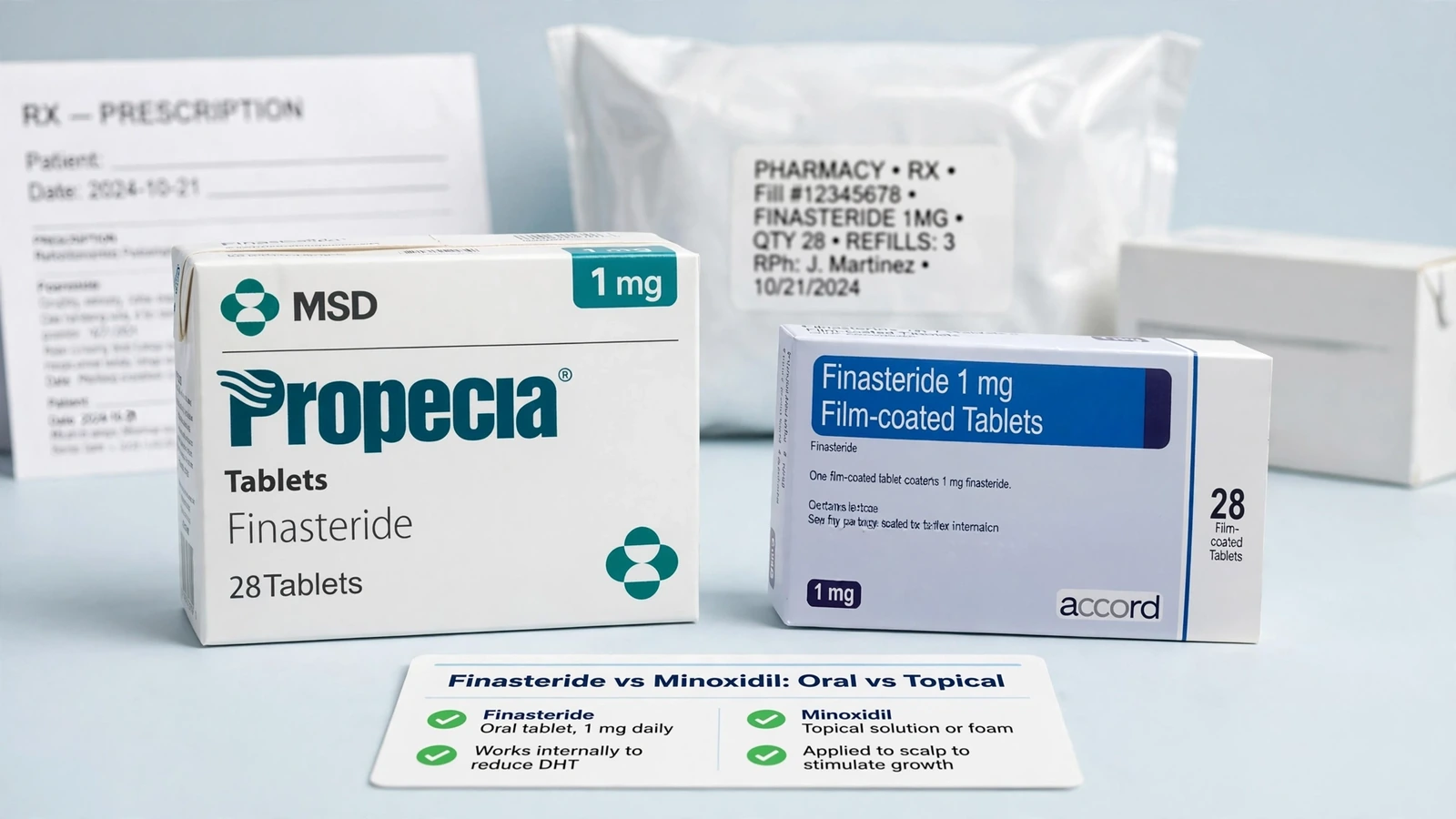
Finasteride is a prescription oral medicine that reduces conversion of testosterone to dihydrotestosterone through type II 5-alpha-reductase inhibition. Topical minoxidil is a nonprescription scalp treatment with a different mechanism and routine. These differences affect access, adverse effects, handling, and adherence.
The comparison begins only after the hair-loss pattern is evaluated. Neither treatment addresses every cause of shedding, inflammation, scarring, or patchy loss. Product choice should not replace diagnosis.
The daily routine can decide whether a plan is realistic
An oral medicine may feel simpler, but it carries systemic risk discussions and prescription requirements. A topical routine avoids swallowing a tablet but requires repeated scalp application and may cause local irritation. Hair texture, styling, travel, work schedule, and comfort with long-term use all affect adherence.
Ask what happens after a missed application or dose, but follow the product label and clinician instructions rather than improvising. More product or double dosing does not safely compensate for inconsistency. For more detail on this decision, review Finasteride Hair Loss Treatment: Diagnosis, Options, and Tracking.
Safety questions are not interchangeable
Finasteride requires discussion of sexual adverse reactions, mood reports, pregnancy handling precautions for damaged tablets, and prostate-related laboratory interpretation. Minoxidil has its own warnings and can cause scalp irritation; product-specific labeling matters. A person’s cardiovascular history, scalp condition, medicines, and preferences may alter the discussion.
Compounded topical finasteride is not simply “the topical version” of approved oral finasteride or nonprescription minoxidil. FDA states that no topical finasteride formulation is FDA approved and has warned about compounded topical products.
Combination plans still need one monitoring strategy
Some clinicians discuss using finasteride and minoxidil together. When two treatments begin at once, it may be harder to identify which one caused an effect or contributed to a benefit. Record start dates, product names, and symptoms. Agree on how and when the combination will be assessed.
Adding treatments should not become an endless response to normal variation. A measured plan defines goals, photo intervals, safety contacts, and reasons to simplify or change. A related clinical question is covered in What a Male Pattern Hair Loss Evaluation Looks For.
Questions to ask before choosing
Ask whether the diagnosis is firm enough for treatment, which route fits the daily routine, what adverse effects should be reported, how pregnancy or household handling applies, and when progress will be reviewed. Also ask how stopping one treatment would affect interpretation if both begin together.
Cost should be compared over the expected duration, not only at the first purchase. Include the prescription evaluation, medicine, applicators, shipping, follow-up, and the time required for a topical routine. A lower monthly product price can still be a poor fit if the routine is abandoned.
Brand presentation should not substitute for ingredient clarity. Confirm the active ingredient, strength, route, and whether a product is FDA approved or compounded. Combination products can make it harder to identify which ingredient caused irritation or another symptom. Keep labels and tell every treating clinician what is actually being used.
Do not compare marketing claims as if they were labels
A branded service may describe convenience or satisfaction, but treatment decisions should use the actual ingredient, route, approved labeling, and clinical context. Check whether the product is an FDA-approved medicine or a compound. Ask whether claims refer to slowing loss, increased hair count, or visible cosmetic improvement.
If the comparison still feels unclear, choose the question that matters most—systemic exposure, scalp routine, cost, adherence, or monitoring—and discuss it directly with the clinician. A simpler sustainable plan can be safer than combining products to cover every possible advantage.
Frequently asked questions
Which treatment is better?
There is no universal answer; diagnosis, goals, routine, and risk tolerance matter.
Can they be used together?
A clinician may discuss combination use for some people.
Is minoxidil prescription only?
Topical minoxidil is available without a prescription, but its label and safety still matter.
Is topical finasteride the same as minoxidil?
No. They are different ingredients, and FDA has not approved a topical finasteride formulation.
Primary and clinical sources
- DailyMed / U.S. National Library of Medicine: Finasteride 1 mg prescribing information — Label updated November 23, 2022; checked August 27, 2026.
- American Academy of Dermatology: What is male pattern hair loss, and can it be treated? — Checked August 27, 2026.
- U.S. Food and Drug Administration: Potential risks associated with compounded topical finasteride products — Published April 22, 2025; checked August 27, 2026.
Educational information only. This page does not diagnose hair loss, provide individualized dosing, guarantee a prescription, or replace urgent or in-person care when needed.