

Monitoring and continuity guide
Metformin Monitoring Through Routine and Acute Changes
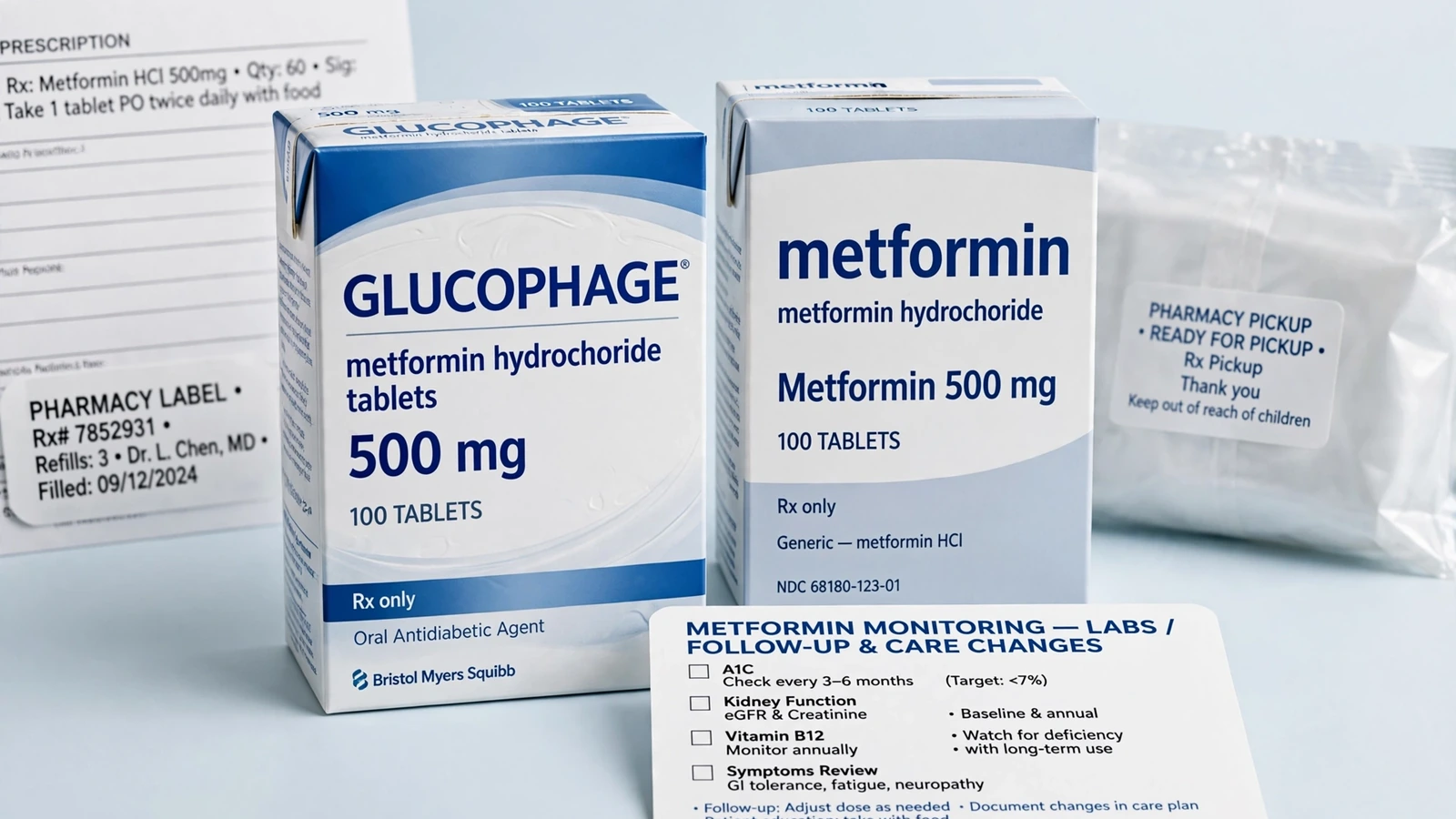
Metformin monitoring connects laboratory results with symptoms, glucose patterns, medicine use and changes in health. Kidney function is checked before treatment and periodically afterward, while A1C and home glucose data serve different purposes. Follow-up should also capture vitamin B12 risk, procedures, missed doses, acute illness and barriers to obtaining medicine.

Medically reviewed by
General internal medicine and preventive medicine
Medical review completed August 27, 2026
A practical route through this decision
Routine review
Bring recent results, medicine use, side effects, home data requested by the care team and any access barriers.
Change review
Report illness, dehydration, hospital visits, procedures, pregnancy, new medicines or a change in alcohol use. For more detail on this decision, review Buy Metformin Online After a Prescription Safety Review.
Action plan
Know which questions can wait, which need same-day advice and which symptoms require emergency care. A related clinical question is covered in Metformin Monitoring and Follow-Up Records That Matter.
| Information | What it adds | What it cannot prove |
|---|---|---|
| eGFR trend | Renal safety context | Overall treatment success |
| A1C | Longer-term glucose picture | Daily highs and lows |
| Home readings | Time-specific patterns | Kidney safety |
| Symptom record | Tolerability and urgency | Cause by itself |
Monitoring is a decision process, not a lab checklist
A result matters because it can change the treatment plan. Kidney function informs metformin safety. A1C helps describe longer-term glucose exposure. Home readings can show time-specific patterns when the care team asks for them. Symptoms may reveal tolerability problems or an urgent change. No single measure replaces the others, and the frequency should be individualized.
Kidney follow-up has two layers
The metformin label calls for renal assessment before initiation and periodically during treatment. Diabetes itself can also affect the kidneys, and NIDDK describes blood and urine testing for diabetic kidney disease. Those are related but not identical questions. A metformin safety check and broader kidney complication screening may involve different tests and interpretation.
A1C and daily readings answer different questions
NIDDK explains that A1C reflects average glucose over roughly three months, while a meter or continuous monitor shows readings at particular times. A1C can also be less reliable in some conditions affecting red blood cells, kidney failure, liver disease or recent transfusion. Treatment decisions should use the right measure for the question rather than chasing one number.
Vitamin B12 deserves symptom context
Current labeling notes that metformin can reduce vitamin B12 levels in some people. Follow-up may consider periodic measurement, especially when anemia, numbness, tingling, fatigue, dietary restriction or other risk factors are present. Testing and treatment should be individualized. An unexplained symptom should not be assigned to metformin without considering other causes.
Medication access is a clinical continuity issue
A delayed refill, insurance rejection, changed pharmacy or unclear product can lead to missed doses. Report the barrier before rationing medicine or substituting a different formulation. The prescriber and pharmacist may need to coordinate quantity, product details or coverage information. A copied online price does not describe the final prescription or benefit.
Acute illness changes the timeline
Vomiting, diarrhea, fever, reduced fluid intake, serious infection or hospital care can make a routine follow-up question more urgent. The person who knows the current kidney function, other medicines and severity of illness should give the plan. A general “sick day rule” from the internet is not individualized enough for every situation.
Missed doses need formulation-aware advice
Official patient information says not to double a dose to make up for one that was missed. The correct next step depends on how close it is to the next dose and the prescribed schedule. Check the label or pharmacist instructions. Repeated missed doses call for a routine, reminder or access problem to be solved rather than repeated improvisation.
Use follow-up to find the real bottleneck
A review should distinguish inadequate response, inconsistent use, an unsuitable schedule, adverse effects, incorrect product handling and an unrelated symptom. That distinction prevents a reflexive dose change. It also clarifies whether the next action belongs with the prescriber, pharmacist, diabetes educator, laboratory, procedure team or urgent care.
The monitoring plan needs an owner for every task
A test order is not complete until someone reviews the result and communicates the next step. Record who ordered kidney or A1C testing, where the result will appear, when it is expected and whom to contact if it is delayed. If several clinicians share diabetes care, designate which one owns medication changes. This simple accountability reduces duplicate orders, missed results and conflicting instructions.
Monitoring frequency changes when risk changes
A stable schedule may no longer fit after reduced kidney function, a hospital stay, repeated dehydration, a new interacting medicine, pregnancy, worsening symptoms or a major treatment change. Conversely, more testing is not automatically better when it does not answer a decision. The care team should connect each planned measurement to a question and explain what result would alter the plan.
Prepare a concise handoff for urgent and routine settings
Keep an updated list with metformin formulation, directions, last dose, allergies, other diabetes medicines, kidney history and emergency contacts. Add recent results only when available; do not guess. During urgent care, state the acute symptoms and hydration first. During routine follow-up, lead with the main decision needed. A concise handoff helps different settings use the same accurate record.
Close the loop after every result
Ask how and when results will be communicated, what change would trigger contact, and whether the next prescription depends on completion. A portal value without interpretation is not a finished monitoring task. Save the final instruction with the medication list so future clinicians can see the reasoning. Confirm that urgent thresholds and routine questions use different contact routes.
Questions readers raise after the main review
How often should kidney function be checked with metformin?
The label requires assessment before treatment and periodically afterward, but the interval is individualized. Age, prior results, acute illness, other medicines and changes in health can justify more frequent review.
Does A1C replace home glucose monitoring?
No. They answer different questions. A1C reflects a longer-term average, while home readings show specific moments and patterns. Use the monitoring plan given by the care team.
What should I bring to a metformin follow-up?
Bring the medication label or list, recent results, requested home readings, missed-dose history, symptom timing, recent care visits, new medicines, planned procedures and questions about access or formulation.
Can I wait until the next visit after vomiting or diarrhea?
Not always. Persistent symptoms and reduced fluid intake can cause dehydration and may change kidney safety. Contact the clinical team promptly, and seek urgent care for severe symptoms or warning signs.
Why can vitamin B12 appear in metformin follow-up?
The current prescribing information notes that metformin can lower vitamin B12 levels in some people. Symptoms and risk factors influence whether testing is appropriate. Fatigue, numbness, tingling, anemia, diet, and treatment duration deserve context rather than an automatic supplement recommendation.
Can I stop metformin when I feel better?
Do not stop or restart metformin on your own. Better home readings do not prove that treatment is no longer needed. A clinician should review glucose trends, current health, kidney function, side effects, and the rest of the diabetes plan before changing therapy.
Primary sources used for this page
- DailyMed: Metformin Hydrochloride Tablets prescribing information. Label updated January 29, 2025; checked August 27, 2026.
- MedlinePlus: Metformin drug information. Revised February 15, 2024; checked August 27, 2026.
- NIDDK: The A1C test and diabetes. Checked August 27, 2026.
- NIDDK: Diabetic kidney disease. Checked August 27, 2026.
Medical information is educational and does not replace diagnosis, prescribing, procedure instructions or emergency care from a clinician who knows the complete record.