
Fluconazole cost and online access should be compared as separate decisions: the clinical assessment, any medicine charge, insurance handling, and pharmacy fulfillment. A lower displayed amount does not answer whether a clinician will prescribe, whether a plan will contribute, or whether the dispensing pharmacy can be verified.
If the treatment decision has not been made, begin with the clinician-led fluconazole pathway for yeast infection. This page starts after that boundary and helps organize the financial and fulfillment questions that can otherwise be hidden behind one checkout total.
Choose the deeper task
Three access decisions need separate answers
The broad access path becomes easier to compare when each unresolved question has one owner. Cost and coverage, pharmacy verification, and brand-versus-generic identity affect different stages. Combining them in a seller comparison can hide which part is clinical, which part is financial, and which part belongs to the dispensing pharmacy.
Estimate and coverage
Build a line-item cost picture
A displayed medicine amount may exclude the clinical assessment, a plan’s network rules, or later care. Use the fluconazole cost and insurance factors to request a written breakdown without treating any estimate as a promise of coverage or prescribing.
Dispensing checkpoint
Verify the pharmacy before the fill
A prescription requirement is only one checkpoint. The licensed-pharmacy checks for fluconazole cover state records, matching business details, pharmacist contact, and what to do when the information does not agree.
Product and label
Confirm what the pharmacy will dispense
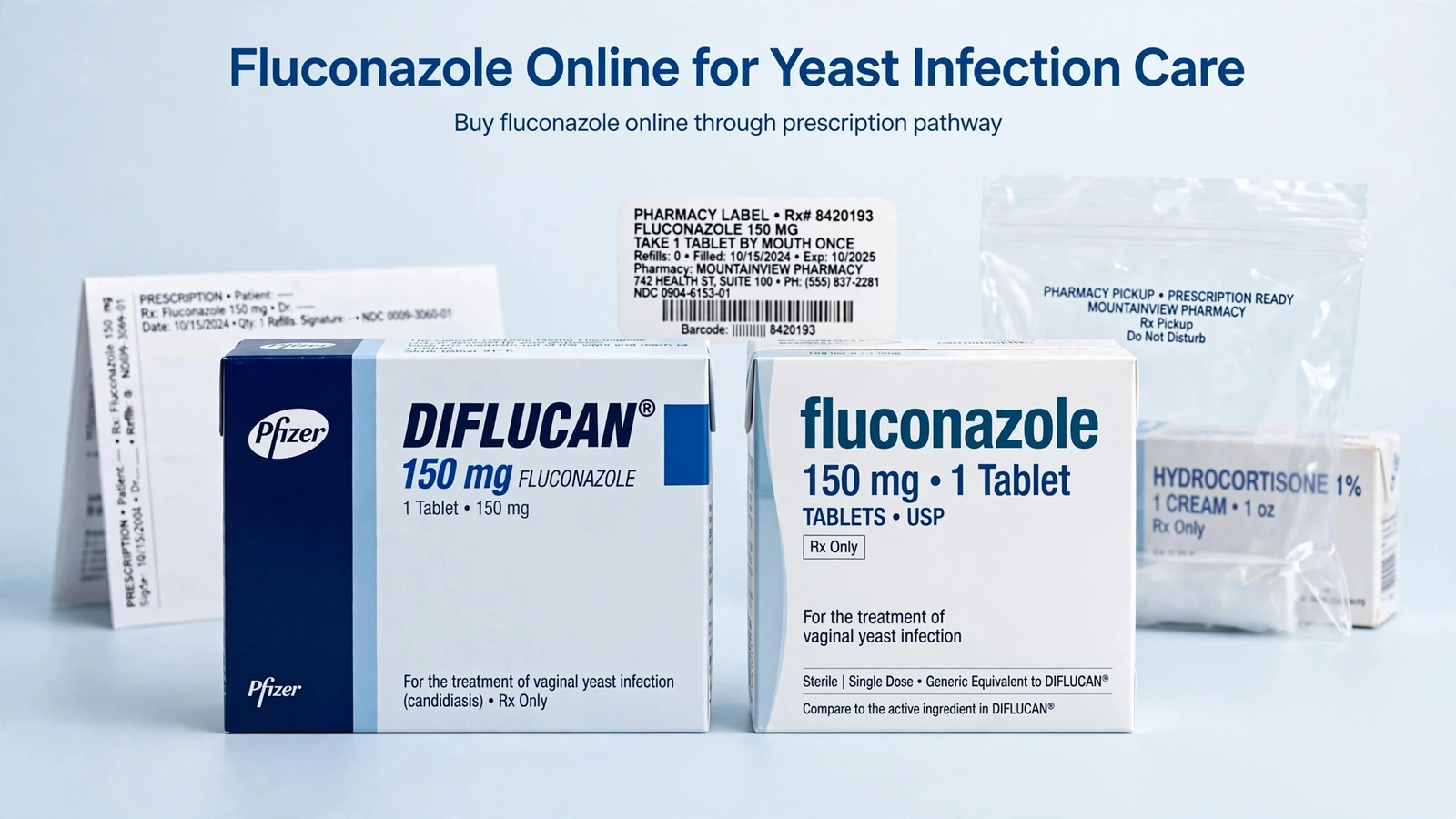
Brand and generic names do not replace the prescription details. Compare Diflucan and generic fluconazole access differences when the label, formulation, plan response, or quoted amount needs clarification from the prescriber or pharmacist.
The displayed total is not the full pathway
What changes fluconazole cost and online access?
Fluconazole cost and online access can change at several handoffs even when the medicine name stays the same. The useful comparison is not a single advertised amount. It is a written record of who charges for each stage, what information is still pending, and which decision can change the final amount.
| Cost component | Who confirms it | What can change | Record to keep |
|---|---|---|---|
| Clinical assessment | Care service | Visit outcome | Fee terms |
| Medicine | Dispensing pharmacy | Product and formulation | Pharmacy quote |
| Insurance contribution | Health plan | Benefit and network rules | Coverage response |
| Pharmacy fulfillment | Licensed pharmacist | Stock and transfer details | Fill status |
| Follow-up care | Prescribing service | Symptoms and next steps | Care instructions |
A service may collect an assessment fee even when a clinician decides that testing or in-person care is safer than a prescription. That is why payment terms and the clinical outcome must remain separate. A pharmacy quote may also change when the prescription, product, or plan response is different from the initial assumption. Ask who can update the estimate and how changes are documented.
Insurance and cash routes create a real tradeoff. A plan route may contribute to a covered product, yet it can involve network or benefit checks. A cash route may provide a simpler quote, but the amount may not reflect plan benefits or count toward plan spending. The page does not select either route. It helps the reader ask for comparable records before deciding.
Medical boundaries come before price
When should the access process stop?
The online access process should pause whenever the diagnosis, prescription details, medicine safety, or pharmacy identity is uncertain. A low quote does not resolve those problems. Severe or rapidly worsening symptoms, a serious reaction, pregnancy-related treatment questions, or symptoms that persist or return need clinical attention rather than another checkout attempt.
Keep each handoff visible
How should an online access path work?
An online access path should show who is responsible at each handoff. The service handles intake and the clinician’s decision, the pharmacy confirms the prescription and product, and the payer answers coverage questions. A receipt alone is not enough; the reader needs a usable record when the decision, quote, or fill changes.
-
Separate the fees
Request distinct assessment, medicine, and fulfillment terms before submitting payment.
-
Wait for the decision
Keep payment separate from whether a clinician considers a prescription appropriate.
-
Verify the pharmacy
Match state records, business details, prescription requirements, and pharmacist contact information.
-
Confirm the final record
Save the product, quote, plan response, pharmacy details, and follow-up instructions.
Payment terms should answer practical questions
Before submitting card or insurance information, look for a written explanation of what the assessment fee covers, whether charges can change after the clinical decision, how cancellation or refund questions are handled, and who resolves a pharmacy problem. A vague total shifts the burden to the patient after payment, when options may be harder to compare.
The U.S. Food and Drug Administration’s BeSafeRx pharmacy information supports checking the prescription requirement, state pharmacy license, and access to a licensed pharmacist. Those checks belong before fulfillment, even when a care service selected or transmitted the prescription to the pharmacy.

Check the record, not the sales claim
Common mistakes before payment
Most access errors begin when one attractive number is treated as the whole decision. A useful comparison keeps the clinical, financial, and pharmacy records distinct. It also leaves room for the outcome to change when symptoms, safety information, a plan response, or the available product does not match the original assumption.
- Assuming payment guarantees a prescription
- Comparing totals with different included services
- Skipping the state pharmacy-license lookup
- Ignoring the exact product and formulation
Edge case: a lower cash quote
Lower now can mean separate plan handling
A cash quote can be easier to understand at the pharmacy counter, but it may sit outside the plan route. Ask whether the quote includes only the medicine, whether the clinical assessment is separate, and whether plan documents will show anything about the transaction. Do not assume the cheapest visible line is the lowest total cost.
Edge case: a product change
A different package needs confirmation
A pharmacy may have a generic product available when a brand name appeared earlier in the path. Confirm the active ingredient, formulation, prescription details, quoted amount, and who answers substitution questions. The practical issue is matching the authorized prescription and the dispensed label, not choosing a product from a marketing image.
Questions that remain after the first estimate
Access questions worth resolving in writing
The first estimate often arrives before every party has responded. These questions help turn a provisional number into a record that can be compared. They do not establish eligibility, coverage, product suitability, or a prescribing outcome.
Does an assessment fee include the medicine?
Not necessarily. Ask the service to identify the assessment charge, pharmacy charge, and any follow-up cost on separate lines. Confirm when each charge becomes final and what happens when the clinician recommends testing, another treatment, or in-person care instead of a fluconazole prescription.
Can an insurance estimate change at the pharmacy?
Yes. A preliminary answer may depend on the final prescription, product, pharmacy network status, and the plan’s current benefit rules. Ask the plan or pharmacy for the reason behind the response and keep the written explanation. The care service should not promise what the health plan will contribute.
What if the pharmacy details do not match?
Pause the fill. Compare the pharmacy name, address, telephone number, website, and state-license record. Contact the state board or the pharmacy through independently verified details when something differs. Do not send health or payment information while the business identity remains uncertain.
Does generic fluconazole always have the same quoted amount?
No single amount applies across pharmacies, products, plans, or cash routes. Ask which product and formulation the quote covers, whether the estimate depends on insurance, and whether a substitution question needs the prescriber or pharmacist. A brand or generic label does not decide whether treatment is appropriate.
What records should I keep after fulfillment?
Keep the clinician’s instructions, product label, pharmacy contact details, payment record, plan response, and follow-up route together. If symptoms persist, a reaction occurs, or the product appears different from what was expected, those records help the clinician and pharmacist understand the original decision without relying on memory.
Primary sources
Clinical and pharmacy-safety claims on this page use the following government sources. Cost and coverage questions are presented as verification tasks because the saved source set does not support a universal price or insurance outcome.
- Fluconazole Prescribing Information — DailyMed, U.S. National Library of Medicine; accessed August 27, 2026.
- BeSafeRx: Know Your Online Pharmacy — U.S. Food and Drug Administration; accessed August 27, 2026.
- CDC Vulvovaginal Candidiasis Recommendations — Centers for Disease Control and Prevention; July 22, 2021.
- Treatment of Candidiasis — Centers for Disease Control and Prevention; April 24, 2024.